Introduction: The Legal Framework of Passenger Rights in Canada
For decades, Canadian airline passengers faced a regulatory vacuum when commercial flights were canceled or delayed. While European travelers enjoyed robust statutory protections under EU Regulation 261/2004, Canadian consumers had little recourse beyond individual airline contracts of carriage (tariffs).
This dynamic changed with the enactment of the **Air Passenger Protection Regulations (APAPR)** by the Canadian Transportation Agency (CTA) under the Canada Transportation Act. The regulations establish clear, legally binding financial obligations for airlines operating flights to, from, and within Canada.
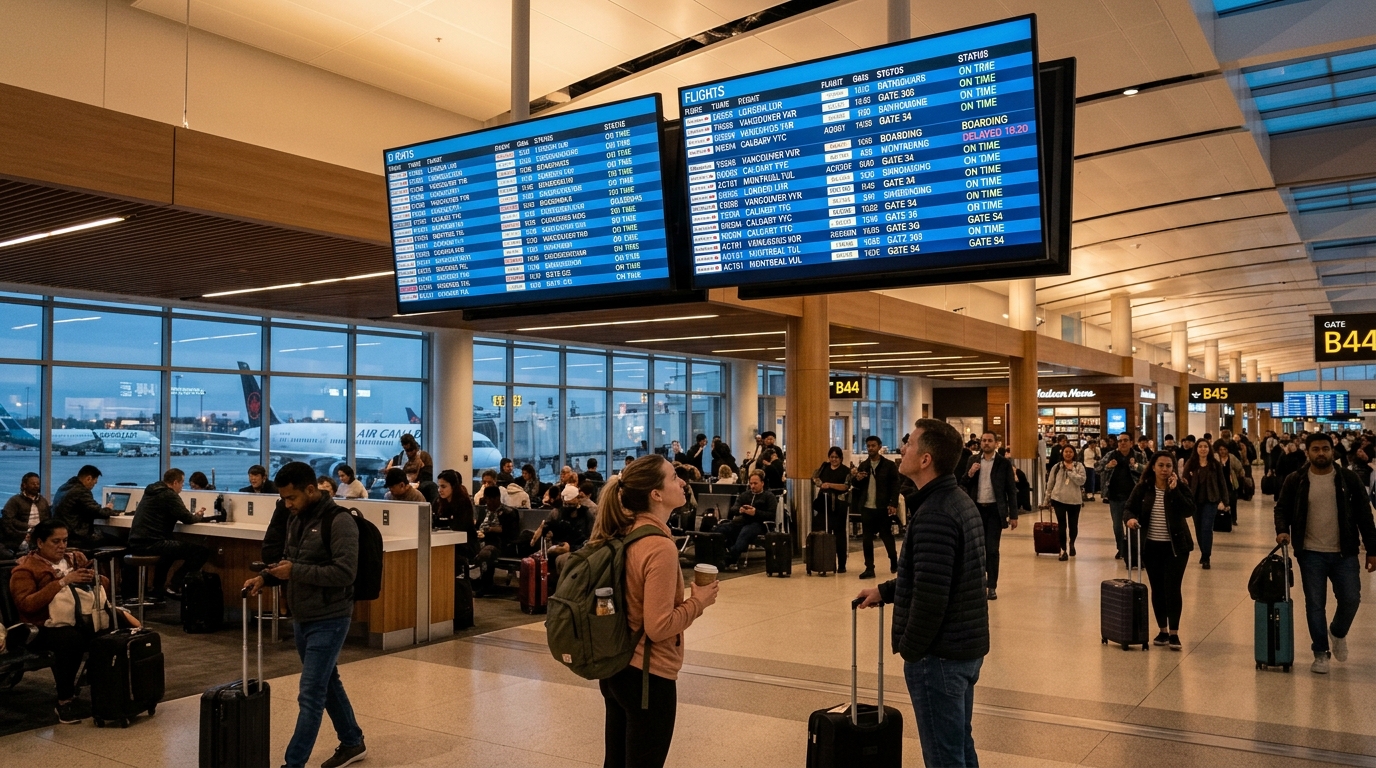
However, navigating APAPR compensation claims requires a deep technical understanding of how regulations categorize delays, what constitutes an "operational safety" exception, and how to preserve evidence when disputes arise. Travelers tracking their delayed departures can cross-reference flight timelines on our live Canadian departures status board.
---
The Three Delay Categories Under APAPR
Under Canadian law, all commercial flight disruptions—whether delays, cancellations, or denied boarding—are classified into one of three statutory tiers:
``` Category 1: Within Airline Control (Full Cash Compensation Mandated) Category 2: Within Airline Control But Required for Safety (Duty of Care Only) Category 3: Outside Airline Control (Weather, ATC, Security - Rebooking Only) ```
1. Delays Within Airline Control Disruptions caused by commercial scheduling errors, commercial overbooking, crew scheduling mismanagement, routine maintenance delays, or IT system failures. In this category, airlines are legally required to provide both **Duty of Care** (meals, hotel, transit) AND **Mandatory Cash Compensation**.
2. Within Airline Control But Required for Safety Mechanical malfunctions discovered during pre-flight inspections that pose a safety hazard, unforeseen structural defects, or regulatory airworthiness directives. In this scenario, cash compensation is exempt under current legislation, but the airline remains strictly obligated to provide meals, hotel accommodation, and prompt rebooking.
3. Outside Airline Control Severe meteorological events, blizzards, lightning strikes, air traffic control ground delay programs, airport security breaches, or medical diversions. Airlines are exempt from cash compensation, but must rebook the passenger on the next available flight within 48 hours or provide a full refund. When winter blizzards trigger delays, ground crews must follow strict [cold-weather de-icing holdover time guidelines](/articles/cold-weather-flight-operations-canadian-airspace-deicing).
---
Statutory Compensation Tiers: Cash Compensation Matrix
If your flight arrives at its final destination delayed by three hours or more, and the disruption was within the airline's control (not safety-related), the carrier must pay statutory compensation based on delay length and airline size:
| Length of Arrival Delay | Large Airlines (Air Canada, WestJet, Porter) | Small Airlines (Regional / Northern Carriers) |
|---|---|---|
| **3 to 6 Hours** | $400 CAD | $125 CAD |
| **6 to 9 Hours** | $700 CAD | $250 CAD |
| **9 Hours or More** | $1,000 CAD | $500 CAD |
*Large Airline Definition:* Any airline that transported two million passengers or more during each of the preceding two calendar years (includes Air Canada, WestJet, Air Transat, and Porter Airlines).
---
Denied Boarding (Involuntary Bumping) Penalties
Involuntary bumping due to oversold aircraft carries even steeper statutory financial penalties under APAPR: - **0 to 6 Hours Delay:** $900 CAD payable immediately at the departure gate. - **6 to 9 Hours Delay:** $1,400 CAD. - **9 Hours or More Delay:** $2,400 CAD cash compensation.
Airlines are strictly prohibited from removing passengers who have already boarded the aircraft, unless safety or unruly passenger protocols require it.
---
The "Safety Loophole" and Recent CTA Legal Precedents
The single greatest source of friction between Canadian consumers and airlines has been the airline industry's frequent classification of delays as "controllable but required for safety."
In landmark rulings (such as *Lau v. Air Canada* and *WestJet v. Canadian Transportation Agency*), federal courts and the CTA clarified that: 1. **Crew Shortages Are Not Automatic Safety Exemptions:** An airline cannot claim crew staffing shortages are a "safety issue" simply because flying with tired crew is unsafe. Crew scheduling is a predictable commercial risk within airline operational control. 2. **Routine Maintenance Is Controllable:** Finding a worn tire or broken lavatory during routine turnarounds cannot be used to escape compensation; airlines are expected to maintain adequate spare parts and redundant aircraft reserves. 3. **Burden of Proof Rests on the Airline:** The airline must present detailed operational logs, maintenance records, and pilot defect reports to substantiate any safety claim.
---
Lost, Damaged, or Delayed Luggage Protections
Under APAPR and the international Montreal Convention (1999), an airline's liability for lost, damaged, or delayed baggage is capped at approximately **1,288 Special Drawing Rights (SDR)**—equivalent to roughly **$2,300 to $2,400 CAD per passenger**. - **Delayed Baggage Expenses:** If your luggage is delayed while traveling away from home, you are legally entitled to claim reimbursement for reasonable interim necessities (toiletries, winter clothing, business attire). - **21-Day Rule:** Luggage not returned within 21 days of arrival is legally declared permanently lost, triggering full claim settlement. - **Deadlines:** File your Property Irregularity Report (PIR) before leaving the airport customs hall. If connecting through complex multi-terminal airports, review our major Canadian transit hubs layover guide to track baggage transfer checkpoints.
---
Step-by-Step Guide: How to File and Win an APAPR Claim
- **Document Everything at the Gate:** Take photos of terminal departure boards showing delay reasons, save boarding passes, record names of gate agents, and save delay text/email notifications.
- **Submit Claim via Official Airline Portal:** Canadian law gives airlines **30 days** to either pay your statutory compensation or provide a detailed written explanation citing the specific regulatory exemption.
- **Escalate to the Canadian Transportation Agency (CTA):** If the airline denies your claim or fails to respond within 30 days, file an official dispute through the CTA dispute resolution portal (otc-cta.gc.ca).
- **Small Claims Court Alternative:** Because the CTA case backlog can take several months, passengers increasingly file expedited actions through provincial small claims tribunals (such as Ontario's Small Claims Court or BC's Civil Resolution Tribunal), where claims are routinely resolved in favor of consumers who maintain clean documentation.
Knowing your statutory rights empowers travelers to fly with confidence across Canadian airspace, ensuring airlines remain accountable to the passengers they serve.