The Collapse of the Decades-Long Duopoly
For nearly three decades following the demise of Canadian Airlines International in 2000, Canada's commercial passenger market was defined by a predictable duopoly. Air Canada, the storied legacy flag carrier, dominated the corporate transcontinental trunk routes, international gateways, and frequent-flyer market. WestJet, founded in Calgary as a scrappy low-cost carrier, grew into a formidable second national network covering both business and leisure travel.
However, the geographic and economic equilibrium of Canadian aviation has entered the most intense structural disruption in modern history. The catalyst is not another ultra-low-cost carrier (ULCC) operating stripped-down vacation flights, but an aggressive, capital-rich fleet expansion executed by Toronto-based Porter Airlines.
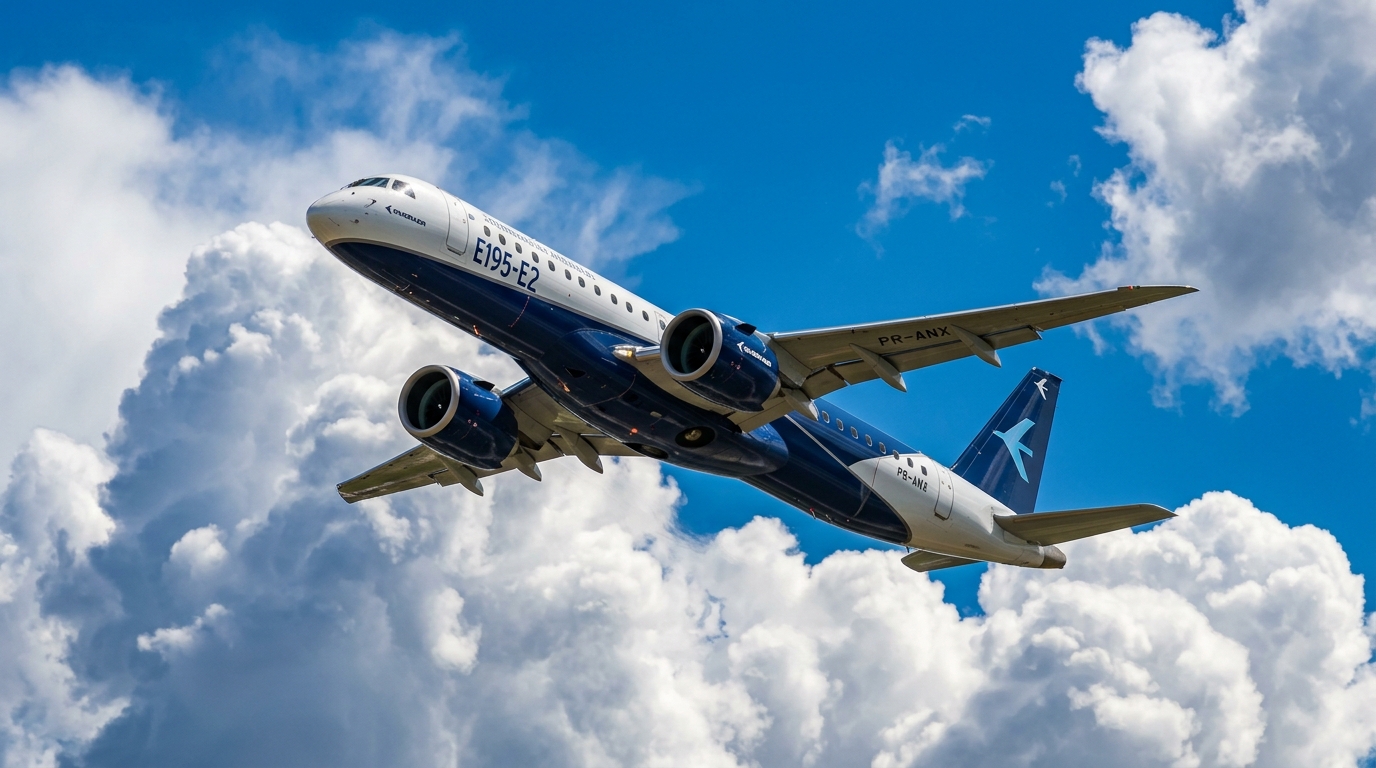
With firm orders and options for up to 100 state-of-the-art **Embraer E195-E2** twin-jets, Porter transitioned overnight from a boutique regional turboprop operator at Billy Bishop Toronto City Airport (YTZ) into a major transcontinental network carrier challenging Air Canada and WestJet head-to-head on high-yield business routes. Travelers can track these competing schedules on our global flight schedules search engine.
---
The Weapon of Choice: The Embraer E195-E2 "Profit Hunter"
At the heart of Porter's transcontinental surge is a deliberate aircraft selection that fundamentally alters route economics: the Embraer E195-E2.
While Air Canada deployed the brilliant Airbus A220-300 and Boeing 737 MAX 8 on transcontinental corridors, and WestJet standardized around the Boeing 737 MAX family, Porter recognized an efficiency sweet spot in the 132-seat E195-E2:
Technical and Aerodynamic Comparison:
| Aircraft Model | Typical Capacity | Max Takeoff Weight (MTOW) | Fuel Burn per Seat | Cabin Cross-Section |
|---|---|---|---|---|
| **Embraer E195-E2** | 132 seats (2-2 configuration) | 61,500 kg | -25% vs legacy E-Jets | 4-abreast (Zero middle seats) |
| **Airbus A220-300** | 137 seats (2-3 configuration) | 70,900 kg | -25% vs legacy narrowbodies | 5-abreast (One middle seat per row) |
| **Boeing 737 MAX 8** | 189 seats (3-3 configuration) | 82,190 kg | -16% vs 737-800 | 6-abreast (Two middle seats per row) |
The "No Middle Seat" Passenger Proposition In passenger experience marketing, Porter pulled off a masterstroke. By configuring the E195-E2 in a pure 2-by-2 seating arrangement, **every single passenger on board is guaranteed either an aisle or window seat**. In an era where legacy air travel has increasingly squeezed seat pitch and added auxiliary fees, offering complimentary premium beer, wine in glassware, Canadian snacks, and high-speed Viasat satellite Wi-Fi on a 5-hour flight from Toronto to Vancouver created instantaneous consumer loyalty.
Airport Noise Compliance and Operational Range Equipped with ultra-high bypass Pratt & Whitney PW1900G Geared Turbofan (GTF) engines, the E195-E2 achieved a 65% reduction in external noise footprint compared to previous-generation aircraft. With a transcontinental range of 2,600 nautical miles, the aircraft easily operates nonstop between [Toronto Pearson (YYZ)](/airport/YYZ), [Ottawa (YOW)](/airport/YOW), [Montréal-Trudeau (YUL)](/airport/YUL), and western cities including [Calgary (YYC)](/airport/YYC), Edmonton (YEG), and [Vancouver (YVR)](/airport/YVR).
---
The Three-Way Tactical Battleground
The battle for Canadian supremacy has divided into distinct strategic geographic theaters:
``` [ WESTJET ] [ AIR CANADA ] [ PORTER AIRLINES ] Western Fortress Focus Global Mega-Hubs Eastern Business Core Calgary Hub Primacy YYZ, YUL, YVR International YYZ Terminal 3 Spoke-Out Sun / Leisure Domination Corporate Contracts Dominance Premium Service Niche ```
1. Air Canada's Fortress Defense Air Canada's competitive moat remains its unmatched global network and international loyalty ecosystem (Aeroplan). A business traveler flying from Halifax to Tokyo or Frankfurt will still favor Air Canada because the domestic transcontinental leg connects seamlessly into widebody Star Alliance networks at Pearson or Vancouver. However, Air Canada has been forced to fiercely defend its domestic corporate pricing on trunk routes, frequently matching Porter's economy fares.
2. WestJet's Strategic Pivot to the West Recognizing the rising pressure in Ontario and Quebec, WestJet executed a dramatic corporate restructuring: pulling back significant eastern domestic flying to double down on its **Western Canada Fortress Strategy**. WestJet concentrated its Boeing 787-9 Dreamliners and 737 MAX fleet around its primary hub at Calgary (YYC), dominating direct routes between the Prairie provinces and sun/leisure destinations in California, Florida, and Mexico.
3. Porter's Network Expansion Strategy Porter is not stopping at Canadian transcontinental corridors. By securing interline and codeshare partnerships with European and US carriers (including Air Transat and Alaska Airlines), Porter is funnelling domestic Canadian traffic directly into transpacific and transatlantic long-haul flights departing from Pearson Terminal 3. Travelers can review detailed terminal connection procedures in our [Canadian transit hubs layover guide](/articles/guide-aeroports-canadiens-correspondances-yyz-yul-yvr).
---
The Broader Economic Impact on Canadian Airfares
For Canadian air travelers, who historically paid some of the highest domestic airfares per passenger-kilometer in the OECD, the Porter expansion has introduced the famous "Southwest Effect" across Canadian trunk routes: - **Price Compression:** Average transcontinental economy fares between Toronto and Vancouver/Calgary dropped by an estimated 15% to 22% on routes where Porter directly challenged incumbents. - **Service Standards Raised:** Legacy competitors were forced to reinstate complimentary snacks and upgrade onboard digital streaming services to match Porter's premium hospitality.
The ongoing Canadian airline war proves that when modern fuel-efficient aerodynamics meet smart commercial strategy, consumers and the aviation industry both emerge victorious.