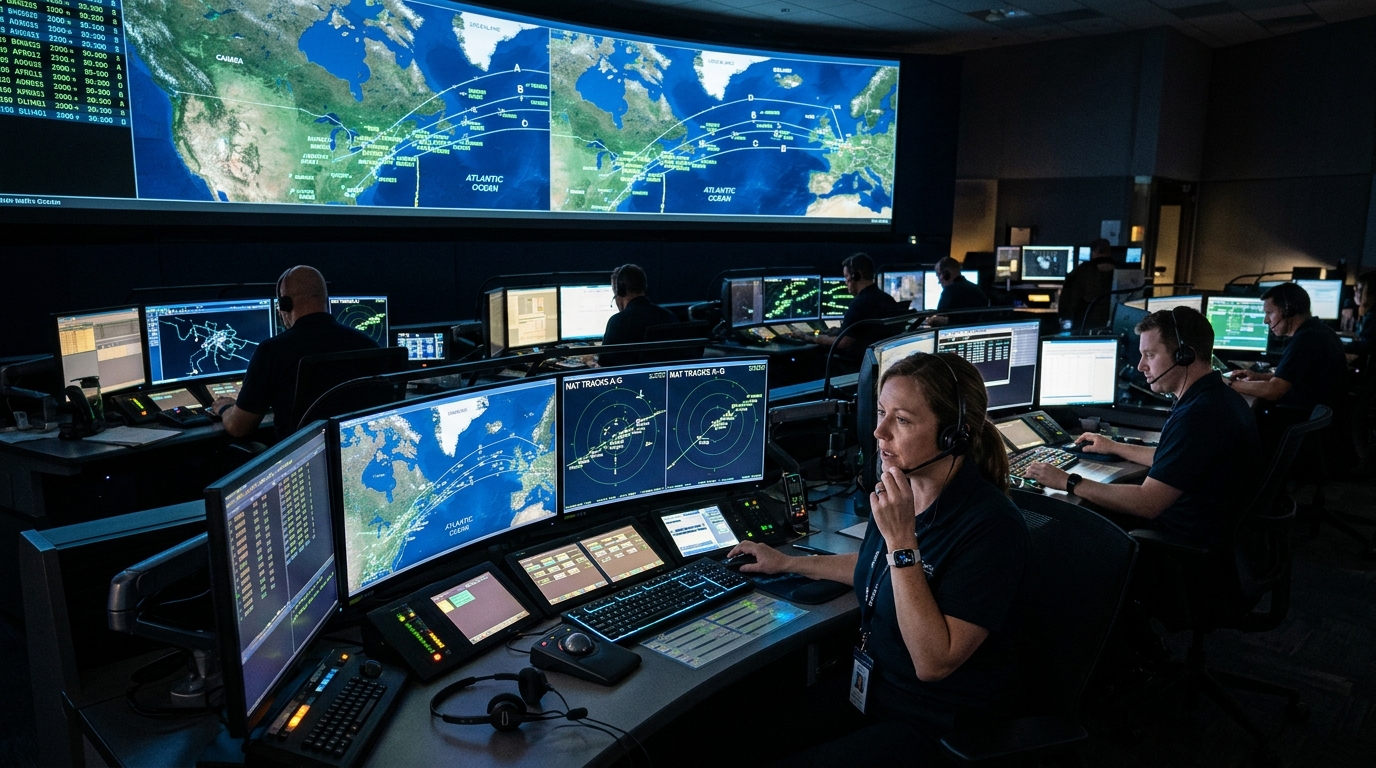
Introduction: The Crossroads of the World
In the quiet town of Gander, Newfoundland, perched on the northeastern edge of the North American continent, sits an unassuming low-rise brick building. Inside this facility operates **Gander Area Control Centre (CZQX)**, run by NAV CANADA.
Together with its sister facility across the ocean—Shanwick Oceanic Control (EGGX) in Prestwick, Scotland—Gander Oceanic is responsible for safe separation across the **North Atlantic**, the busiest, most commercially critical transoceanic flight corridor on the planet. Every day, between 1,200 and 2,000 widebody passenger and cargo flights shuttle between North American financial centers (New York, Chicago, Toronto, Montreal) and European capitals (London, Paris, Frankfurt, Amsterdam).
Because this vast expanse of cold ocean water historically lacked ground-based secondary surveillance radar, Gander developed the most sophisticated procedural air traffic management protocols in human history. To explore flights currently traversing Canadian airspace, view our live global flight timetables.
---
The Architecture of the Organized Track System (OTS)
The North Atlantic flight corridor is not a static highway. Instead, it is a dynamic, fluid system re-engineered twice every 24 hours to capitalize on global meteorological patterns: the **Organized Track System (NAT-OTS)**.
The Jet Stream Engine At cruising altitudes between Flight Level 300 and 400 (30,000 to 40,000 feet), high-altitude winds known as the **Polar Jet Stream** blow from west to east at speeds frequently reaching 120 to 180 knots (220 to 330 km/h). - **Eastbound Flights (North America to Europe):** Want to fly directly inside the core of the jet stream to capture a massive 150-knot tailwind, cutting flight times by up to an hour and saving thousands of kilograms of aviation fuel. - **Westbound Flights (Europe to North America):** Want to evade the jet stream at all costs, tracking north over Greenland and northern Canada to avoid punishing headwinds.
``` Daytime (Westbound Flow - Europe to North America): Tracks labeled alphabetically: A, B, C, D, E, F... (Effective 11:30 UTC to 19:00 UTC)
Nighttime (Eastbound Flow - North America to Europe): Tracks labeled in reverse: Z, Y, X, W, V, U... (Effective 01:00 UTC to 08:00 UTC) ```
Gander and Shanwick dispatchers analyze satellite wind models and airline route requests, publishing the daily track message containing exact oceanic entry waypoints (such as CARPE, REDBY, or TUSKA), oceanic grid coordinates (e.g., 52°N 50°W, 53°N 40°W), and European landfall fixes. Real-time satellite surveillance of these tracks is powered by the Aireon space-based ADS-B constellation.
---
Separation Standards: The Mach Number Technique
Because aircraft along an oceanic track cannot be visually vectored by radar controllers to change headings, Gander controllers enforce the **Mach Number Technique**: 1. **Speed Locked to True Mach:** Airliners do not fly based on indicated airspeed; they are assigned a strict, constant Mach number (e.g., "Air Canada 860, maintain Mach decimal eight zero"). 2. **Preventing Catch-Up:** By locking leading aircraft to a faster or identical Mach number than following aircraft, controllers guarantee that trailing jets will never overtake leading jets along the same oceanic track. 3. **Altitude Layering:** Tracks are vertically stacked at 1,000-foot intervals under Reduced Vertical Separation Minimums (RVSM), with flight levels ranging from FL320 to FL410.
---
Oceanic Clearances and Communications: From Morse Code to CPDLC
The communication methods used to navigate Gander Oceanic have evolved from hazardous high-frequency radio clicks to instantaneous digital satellite datalinks:
Legacy High-Frequency (HF) Radio Aircraft crossing the Atlantic were required to contact Gander Radio on crackling HF frequencies (such as 5616 kHz or 8891 kHz). Due to solar flare ionospheric interference, voice transmissions were often nearly unintelligible, requiring human operators in Gander to repeat coordinates three to four times.
Controller-Pilot Data Link Communications (CPDLC) Today, modern flights utilize FANS 1/A (Future Air Navigation System) CPDLC: - The flight crew requests their oceanic clearance digitally via ACARS text messaging 30 to 90 minutes prior to entering the Gander Oceanic Flight Information Region (FIR). - Gander's automated air traffic computers verify speed, entry time, and route spacing, transmitting a digital clearance directly into the aircraft's Flight Management Computer (FMC). - The crew reviews the text message on their cockpit multifunction display and presses "ACCEPT," digitally binding the clearance without exchanging a single spoken word.
---
ETOPS and Emergency Oceanic Diversion Aerodromes
One of the most vital responsibilities of Gander controllers is managing emergency diversions under **Extended-range Twin-engine Operational Performance Standards (ETOPS)**.
Commercial twin-engine jets—such as the Airbus A350, Boeing 777, and Airbus A220-300—flying over the ocean must always remain within a certified single-engine flying time (e.g., ETOPS 180 or 240 minutes) of an adequate emergency diversion airport.
Canada’s Critical North Atlantic Diversion Airports: 1. **Gander International Airport (YQX):** Famous for hosting 38 commercial airliners and nearly 7,000 stranded passengers during Operation Yellow Ribbon on September 11, 2001, Gander's massive 10,200-foot runway 13/31 can accommodate any widebody jet in existence. 2. **CFB Goose Bay (YYR), Labrador:** A joint military-civilian airfield featuring two 10,000-foot runways and emergency military rescue support. 3. **St. John’s International (YYT), Newfoundland:** Canada's easternmost commercial airport, ideal for immediate medical diversions before flights venture past the 50th meridian. 4. **Keflavik International (KEF), Iceland:** The mid-ocean sentinel providing emergency refuge when flights encounter medical emergencies or cabin depressurization along northern tracks. If flight diversions result in extended transit delays, passengers are protected under the [Canadian Air Passenger Protection Regulations (APAPR)](/articles/canadian-air-passenger-protection-regulations-apapr-compensation-guide).
The men and women of Gander Oceanic Control represent an invisible pillar of world civil aviation, watching over the Atlantic skies with quiet professionalism to ensure every crossing is a journey safely completed.