Introduction: The Invisible Violence of Clear Air
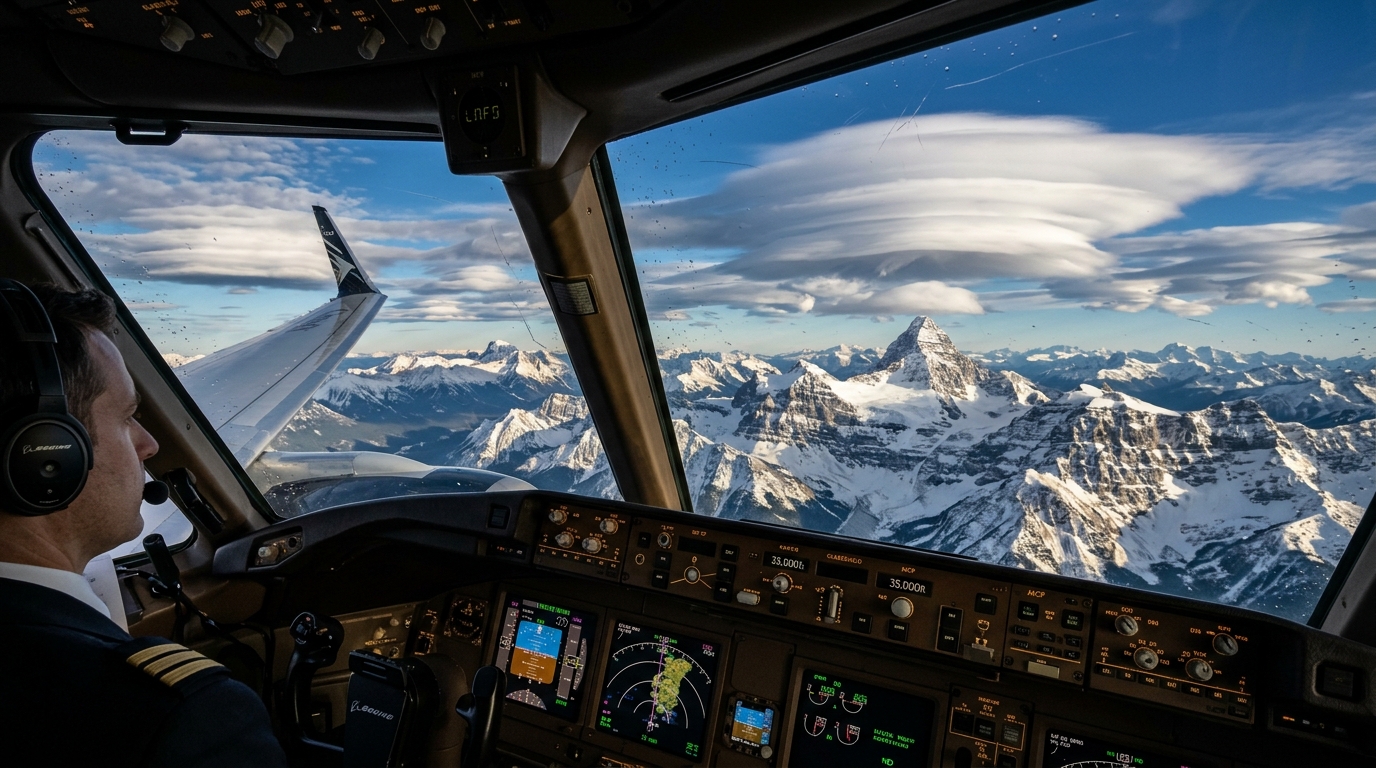
To the passenger reposing at 36,000 feet above the snow-capped crests of the Canadian Cordillera, the sky appears serene, boundless, and motionless. Suddenly, without a cloud on the horizon, the aircraft experiences a violent, shuddering vertical acceleration. Cups rattle, unrestrained objects launch toward the ceiling, and the wingtips flex through meters of aerodynamic deflection.
The flight has struck **Clear-Air Turbulence (CAT)** generated by a high-altitude **Mountain Wave**.
Across western Canada—spanning British Columbia, Alberta, and the Yukon—the interaction of powerful jet streams with steep topography produces some of the most intense mesoscale atmospheric wave phenomena observed anywhere in global aviation. Understanding the physics behind these atmospheric perturbations is essential for airline dispatchers, flight crews, and meteorologists. Real-time flight tracking through these mountain corridors is monitored on our interactive live ADS-B flight radar tracking map.
---
Atmospheric Physics: How Mountain Waves Form
A mountain wave is an atmospheric gravity wave generated when a stable layer of air is forced over a topographical barrier. Unlike surface mechanical turbulence, which dissipates within a few thousand feet of the ground, mountain waves are buoyant oscillations that can penetrate high into the stratosphere.
Three Meteorological Prerequisites: 1. **Perpendicular Wind Flow:** Wind direction at mountain ridge crest must strike within 30 degrees of perpendicular to the mountain range axis. 2. **Speed Threshold:** Wind velocity at the mountain crest altitude (typically 8,000 to 10,000 feet in the Rockies) must exceed a minimum threshold of 25 to 30 knots. 3. **Vertical Wind Shear with Height:** Wind speed must increase continuously with altitude, frequently associated with the core of a polar or subtropical jet stream aloft exceeding 80 to 120 knots.
``` Wind Profile ---> [ Stratosphere / Tropopause ] Increasing with Height Wave Crest (FL380) / \ Ridge Wind (30 kts) -> [ Mountain Ridge ] - - Wave Trough - - Wave Crest | [ Rotor Zone - Severe CAT ] ```
When stable air is pushed over the Continental Divide, gravity forces the displaced air mass to sink rapidly down the leeward slope. Sinking air warms adiabatically and becomes less dense than its surroundings, causing it to bounce upward once it clears the valley floor. This buoyant restoring force triggers an atmospheric wave that propagates downstream for dozens—sometimes hundreds—of miles.
---
Kelvin-Helmholtz Instability: The Engine of Clear-Air Turbulence
While laminar mountain waves can sometimes be flown smoothly, turbulence occurs when the wave breaks. The primary physical mechanism driving wave breaking is the **Kelvin-Helmholtz (K-H) Instability**.
When high-velocity air in the upper wave crest slides over slower-moving air beneath it, a severe velocity shear is created. If the velocity difference exceeds a critical mathematical threshold, the interface between the two air layers curls over on itself like an ocean wave breaking on a beach:
The Richardson Number (Ri) Criterion Atmospheric stability vs. wind shear is quantified by the non-dimensional **Richardson Number (Ri)**:
$$Ri = rac{ rac{g}{ heta} \left( rac{\partial heta}{\partial z} ight)}{\left( rac{\partial u}{\partial z} ight)^2 + \left( rac{\partial v}{\partial z} ight)^2}$$
- **Ri > 0.25:** Flow remains dynamically stable; waves remain laminar without breaking.
- **Ri ≤ 0.25:** Shear overcomes atmospheric stability! The wave breaks into violent turbulent vortices, producing severe Clear-Air Turbulence capable of generating vertical accelerations exceeding +2.0g to -1.0g on transport category airliners. Similar cockpit handling procedures are analyzed in our [inside the cockpit Rockies flight dispatch Q&A](/articles/inside-the-cockpit-canadian-rockies-flight-dispatch-qa).
---
Rotor Zones and Visual Warning Signs
At lower altitudes beneath the wave crests (typically between 5,000 and 15,000 feet), dangerous circulatory eddies known as **Rotors** develop. Rotors combine hurricane-force downdrafts with intense directional wind shear, presenting severe hazards during approach and landing at airports such as Calgary (YYC), Cranbrook (YXC), and Castlegar (YCG).
Visual Clues in the Sky: - **Altocumulus Lenticularis (Lenticular Clouds):** Smooth, stationary, saucer-shaped clouds formed at the crest of mountain waves where moist air cools to its dew point. To pilots, a lenticular cloud is a neon sign screaming: *Severe wave activity aloft!* - **Rotor Clouds (Roll Clouds):** Ragged, tumbling cumulus fractus clouds forming beneath the wave crest, displaying rapid circular rotation along a horizontal axis. - **The Clear-Air Hazard:** When relative humidity is below 30%, no condensation occurs. The sky remains sapphire blue, yet the turbulent wave energy remains fully active.
---
NAV CANADA Forecasting and Turbulence Avoidance
To safeguard commercial aviation across the Rockies, NAV CANADA's Canadian Meteorological Aviation Centre (CMAC) utilizes cutting-edge mesoscale modeling: 1. **High-Resolution Deterministic Prediction System (HRDPS):** A 2.5-kilometer grid numerical weather model that explicitly resolves mountain wave oscillations and gravity wave drag. 2. **SIGMET Bulletins (Significant Meteorological Information):** Issued immediately when severe mountain waves or turbulence are observed or forecast. 3. **PIREP Relays (Pilot Weather Reports):** When an airliner encounters moderate or severe turbulence, the crew transmits a PIREP via voice or ACARS. NAV CANADA controllers immediately broadcast the report to all trailing aircraft, enabling dispatchers to reroute flights or assign alternate flight levels.
Passenger Safety: The Golden Rule of the Seatbelt
Modern aerospace engineering constructs aircraft with immense structural strength; modern carbon-composite wings on jets like the Airbus A220-300 or Boeing 787 can flex upward by over 20 feet without structural failure.
The true hazard of Clear-Air Turbulence is not that the plane will break, but that **unrestrained passengers and cabin crew will be thrown into overhead bins and ceilings**. Aviation injury statistics demonstrate that over 90% of serious turbulence injuries occur to passengers who ignored the illuminated fasten-seatbelt sign.
Understanding the atmospheric physics of mountain waves reveals the delicate dance between raw planetary forces and the precision predictive science that keeps Canadian commercial flight corridors among the safest in the world.