Introduction: The Invisible Currency of Civil Aviation
To the traveling public, booking an airline ticket appears to be a simple transaction of choosing a departure time on a smartphone app. An airline decides to fly from Toronto Pearson (YYZ) to Vancouver (YVR) at 8:00 AM, and the flight appears on the schedule.
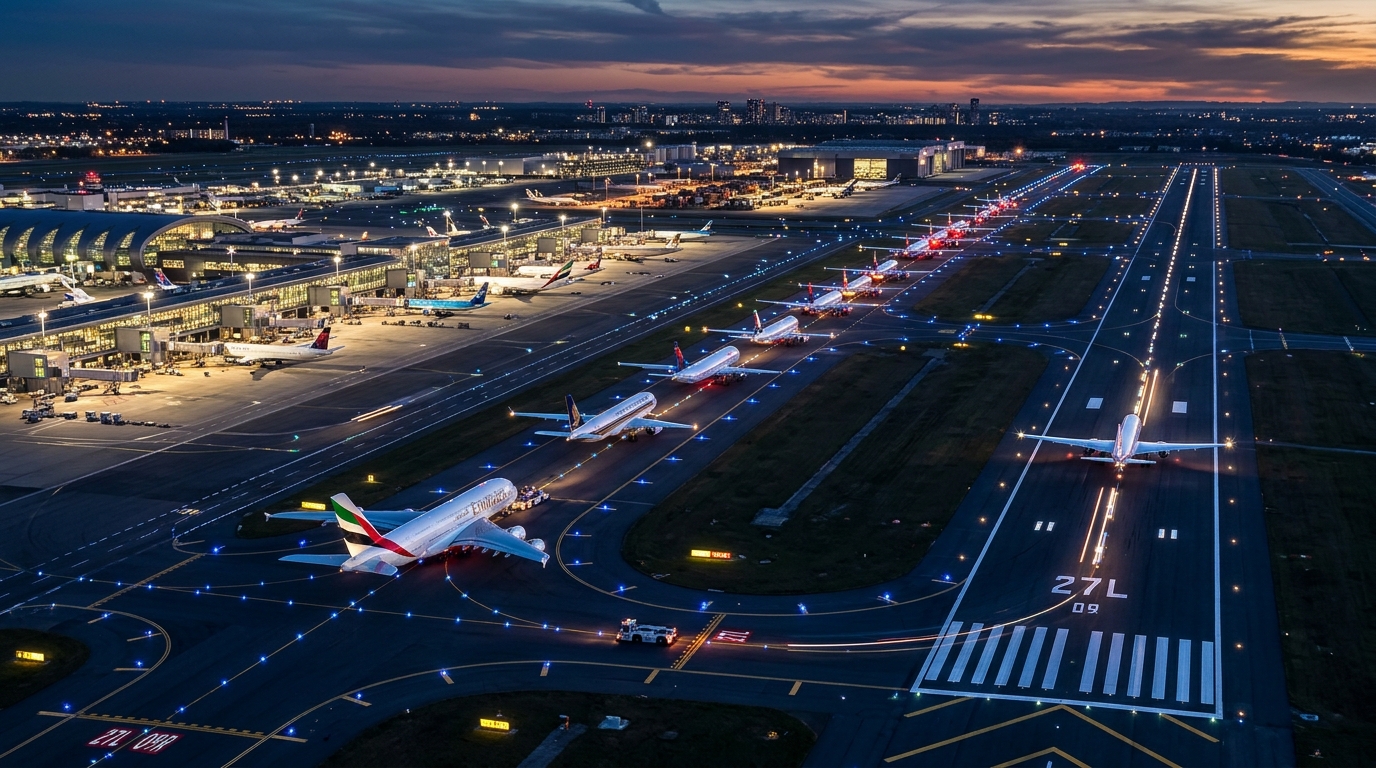
In reality, commercial airlines cannot simply fly to major airports whenever they please. Airspace, taxiways, passenger terminal gates, and runways are finite physical assets. At the world's busiest international hubs, the right to take off or land an aircraft at a specific time is governed by one of the most fiercely contested, economically valuable assets in global commerce: the **Airport Takeoff and Landing Slot**.
Understanding how slots are coordinated, how the IATA Worldwide Airport Slot Guidelines (WASG) function in Canada, and why runway separation physics dictate airport capacity reveals the hidden engineering that governs every flight listed on our global flight timetables directory.
---
The Three IATA Airport Capacity Levels
The International Air Transport Association (IATA) classifies every commercial airport in the world into one of three structural categories based on demand versus capacity:
``` IATA Level 1: Non-Coordinated Airport (Capacity exceeds demand; open access) IATA Level 2: Slot-Facilitated Airport (Schedules facilitated during peak hours; voluntary cooperation) IATA Level 3: Fully Coordinated Airport (Demand exceeds capacity; mandatory slot allocation required) ```
Level 1: Non-Coordinated (e.g., Kelowna, Moncton) Airports where runway, gate, and airspace infrastructure can accommodate all airline schedule requests with minimal delay. Airlines simply file flight plans with NAV CANADA.
Level 2: Slot-Facilitated (e.g., Calgary YYC, Ottawa YOW during peak events) Airports experiencing seasonal or time-of-day congestion. An appointed schedule facilitator works with airlines to voluntarily de-peak flights and prevent bottlenecks.
Level 3: Fully Coordinated (Toronto Pearson International - YYZ) At Level 3 airports, demand for runway movements and terminal gates vastly exceeds physical capacity throughout the day. **No airline is legally permitted to operate a commercial flight without first being formally allocated a certified slot by the independent Airport Coordinator.** At YYZ, slot coordination is managed by Airport Coordination Limited (ACL) under strict IATA regulations.
---
Runway Physics: What Limits Airport Capacity?
Why can't an airport like Toronto Pearson simply handle 120 flights per hour? The hard ceiling on runway operations is dictated by aeronautical physics: **Wake Turbulence Separation**.
When a heavy widebody jet—such as an Air Canada Boeing 777-300ER—takes off or lands, its wingtips shed powerful, tornado-like counter-rotating vortices of turbulent air. If a smaller regional jet, such as an Airbus A220-300 or Embraer E195-E2, follows too closely behind, the wake vortex can roll the trailing aircraft uncontrollably:
RECAT-Canada Wake Separation Rules: - **Super / Heavy behind Heavy:** 4 nautical miles separation required. - **Medium behind Heavy:** 5 nautical miles separation (roughly 2 minutes of buffer). - **Light behind Heavy:** 6 nautical miles separation.
``` Runway Threshold: [ Heavy Widebody ] ===== Wake Vortex Zone =====> [ Trailing Jet (Must Wait 2 Min) ] ```
When winter snowstorms require runway clearing or aircraft require de-icing, the runway acceptance rate drops by an additional 30% to 50%. Review our operational guide to cold-weather de-icing and runway friction index (CRFI) to understand winter throughput drops.
---
The Golden Rule: Grandfather Rights and the 80/20 "Use-It-or-Lose-It" Rule
How do airlines maintain control over highly lucrative slots (such as an 8:00 AM Monday departure from YYZ to London or New York)? The foundation of slot law is the **Grandfather Right** system: - **Historic Precedence:** If an airline operated a specific slot during the previous equivalent season (Summer or Winter), it holds historic priority to claim that identical slot for the upcoming season. - **The 80/20 Use-It-or-Lose-It Mandate:** To retain grandfather rights, the airline must prove that it actually operated the slot for at least **80% of the allocated scheduling season**. If an airline cancels flights or fails to utilize the slot above the 80% threshold, it automatically forfeits the slot back into the **General Pool**.
The 50/50 New Entrant Pool When slots are surrendered into the general pool or created through airport infrastructure improvements (such as new taxiway high-speed exits), the slot coordinator must allocate **50% of all available pool slots to New Entrants** (airlines holding less than 5% of total airport slots). This regulatory mechanism is the critical pathway that allowed carriers like [Porter Airlines](/airline/PD) to expand their E195-E2 transcontinental schedules out of Pearson Terminal 3.
---
Airport Slot Secondary Trading: The Multi-Million-Dollar Shadow Market
In major global financial hubs (particularly London Heathrow and New York JFK), slots are so scarce that they are treated as multi-million-dollar capital assets. In 2016, Oman Air paid a record **$75 million USD** to Kenya Airways for a single early-morning arrival slot pair at Heathrow!
While Canadian regulations do not permit direct cash sale of airport slots, airlines engage in complex slot swaps and commercial lease transfers. Understanding these slot assets explains why major carriers fiercely protect their flight schedules, even running near-empty flights during industry downturns solely to preserve their 80/20 regulatory utilization threshold.
Terminal Gate and US Preclearance Constraints
Runway slots are only one half of the equation; an aircraft that lands must also have an available parking gate and customs inspection capacity.
At Canadian hubs with US CBP Preclearance facilities, slot coordinators enforce passenger throughput caps per hour. The US customs hall has a finite number of biometric processing lanes and officers. If three widebody jets arrive simultaneously at 3:00 PM, the passenger overflow would exceed terminal safety codes; therefore, flight departure slots are mathematically spaced to match customs processing capacity.
Airport slot coordination is the invisible symphony that synchronizes runway aerodynamics, customs staffing, gate mechanics, and airline commercial ambitions, ensuring the global air transport network operates with mathematical precision.