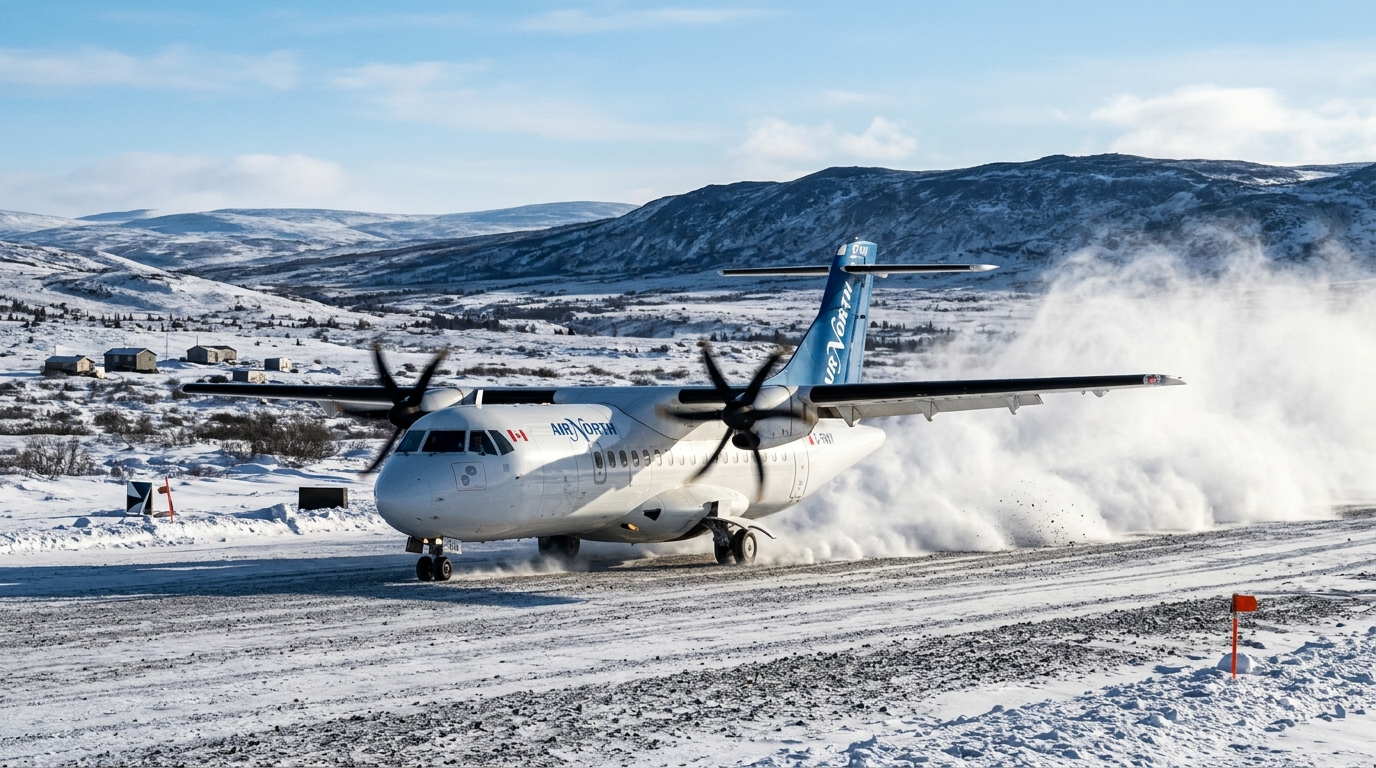
The Vast Northern Reality: No Roads, Only Runways
To comprehend the sheer scale and necessity of Arctic aviation in Canada, one must first confront a geographic truth: across millions of square kilometers comprising the Northwest Territories, Nunavut, and northern Quebec (Nunavik), there are virtually no highways connecting human settlements.
Communities such as Cambridge Bay (Ikaluktutiak), Pangnirtung, Grise Fiord, and Pond Inlet are separated from southern Canadian industrial supply chains by thousands of kilometers of frozen tundra, sea ice, and treacherous mountain ranges. For the 40,000 residents of Nunavut and 45,000 residents of the Northwest Territories, aviation is not an optional travel luxury; it is the sole umbilical cord sustaining human civilization.
Everything—from fresh milk, vegetables, and baby formula to diesel generators, cardiac medication, mining machinery, and emergency surgical evacuations (MEDEVAC)—moves through the air cargo bays of northern carriers such as Canadian North, Air North, and Calm Air. When polar storms close local airports, dispatchers monitor real-time diversions on our live Canadian airspace tracking map.
---
The Engineering Wonder: Boeing 737 Unpaved Runway Kits (Gravel Kits)
Operating modern high-bypass commercial turbofans onto unpaved Arctic runways presents a brutal physics challenge: jet engine foreign object damage (FOD).
When a jet aircraft lands on an unpaved gravel, dirt, or crushed-shale strip at 130 knots, its tires spray a barrage of sharp, high-velocity stones. Simultaneously, powerful turbofan engine intakes create intense low-pressure aerodynamic vortexes that pull loose rocks directly off the ground and into the titanium fan blades, destroying compressor stages in seconds.
To conquer this hazard, Boeing and Canadian Arctic operators developed the legendary **Boeing 737 Unpaved Strip Kit (Gravel Kit)**, primarily certified on the classic Boeing 737-200 and select modern retrofits:
Key Components of a Gravel Kit: 1. **Nose Gear Gravel Deflector:** A large, aerodynamically contoured fiberglass and aluminum ski-like deflector mounted directly to the nose landing gear assembly. The deflector extends downward toward the gravel surface, trapping flying debris thrown up by the dual nose wheels and deflecting it harmlessly beneath the fuselage. 2. **Vortex Dissipators (Bleed Air Blowers):** Two forward-projecting hollow metallic tubes mounted beneath the engine nacelles, extending several feet ahead of the intake lips. High-pressure engine compressor bleed air is piped through these tubes and blasted downward through precision nozzle orifices toward the ground. This continuous supersonic air jet disrupts the ground vortex, preventing the formation of the suction tornado that pulls gravel into the intake. 3. **Flap and Fuselage Armor:** Heavy-duty Teflon and stainless-steel plating riveted to the lower fuselage skin and the leading edges of the trailing-edge flaps to absorb stone impacts without puncturing hydraulic lines. 4. **Retractable Anti-Collision Light:** The lower fuselage beacon light retracts flush into the fuselage belly during takeoff and landing on gravel to prevent shattered lens glass.
---
The Combi Configuration: Half Cargo, Half Passengers
Arctic economics differ fundamentally from southern airline dispatch. While a Toronto-to-Montreal commuter flight fills 180 seats with business travelers carry-on bags, an Arctic flight from Yellowknife (YZF) to Cambridge Bay (YCB) might require transporting only 30 passengers, but simultaneous cargo demand for three pallets of fresh produce, an emergency snowmobile engine, and medical supplies.
To solve this economic equation, northern operators perfected the **Combi Aircraft**: - **Main Deck Cargo Door:** A massive hydraulic cargo door installed on the forward port side of the fuselage. - **Movable Bulkhead Barrier:** A certified 9G crash-resistant bulkhead wall that can be locked into various cabin track positions, splitting the cabin into: - 3 Pallet Cargo Bays / 72 Passenger Seats - 4 Pallet Cargo Bays / 40 Passenger Seats - Full Freighter Mode (All Cargo) - **Roller Floors:** Aircraft cabin floors equipped with built-in ball-mat transfer plates and roller tracks, allowing ground handlers to slide 4,000-pound IATA LD3 cargo containers into the forward cabin before passenger boarding begins.
---
Sub-Zero Cold-Soak Avionics and Ramp Logistics
Operating at -45°C ambient temperatures introduces metallurgical and chemical challenges that southern airline crews never encounter: 1. **Hydraulic Viscosity:** Standard aviation hydraulic fluid (such as Skydrol LD-4) thickens dramatically when cold-soaked overnight on an unheated Arctic apron. Flight crews must execute specialized hydraulic cycling procedures, slowly exercising flight control surfaces (ailerons, elevators, spoilers) before taxiing to avoid blown hydraulic pump seals. 2. **Fuel Freezing Points:** Standard Jet A fuel has a freeze point of -40°C. In the high Arctic, airlines must uplift Jet A-1 (certified down to -47°C) or Jet B / TS-1 (a naphtha-kerosene blend certified down to -60°C). Flight dispatchers closely monitor fuel tank temperature sensors throughout long polar cruise segments; if fuel temperature approaches within 3°C of the freeze point, crews must increase Mach speed (generating aerodynamic skin friction heating) or descend to warmer atmospheric layers. 3. **Engine Cold-Starting:** Ground power units (GPUs) and auxiliary power units (APUs) must run continuously; shutting down an engine overnight on an exposed ramp in Iqaluit (YFB) without external heater tents will cause engine oils to solidify into an impassable paste. Similar strict engine monitoring procedures are practiced by Canadian Rockies cockpit crews.
---
Navigating Without Ground NavAids: The True North vs Magnetic Polar Challenge
Flying in the Canadian Arctic also presents unique navigational complexity: the proximity of the **Magnetic North Pole**.
In the Canadian Northern Domestic Airspace (NDA), magnetic compasses become completely erratic and useless due to steep vertical magnetic dip angles. Furthermore, magnetic declination can change by 30 degrees over a short 200-mile flight leg. - **True North Navigation:** Aircraft operating in the Northern Domestic Airspace must switch primary flight displays and autopilot references from Magnetic North to **True North** heading. - **GNSS/GPS Satellites:** Modern operations rely heavily on dual Multi-Sensor Flight Management Systems (FMS) cross-referencing GPS and GLONASS constellation signals, complemented by space-based ADS-B monitoring provided by NAV CANADA's Aireon satellite constellation.
Through extraordinary engineering innovations—from gravel deflectors to True North avionics—Canada's northern aviators demonstrate daily that no matter how hostile the Arctic climate, the vital airborne lifeline linking remote northern communities remains unbroken.